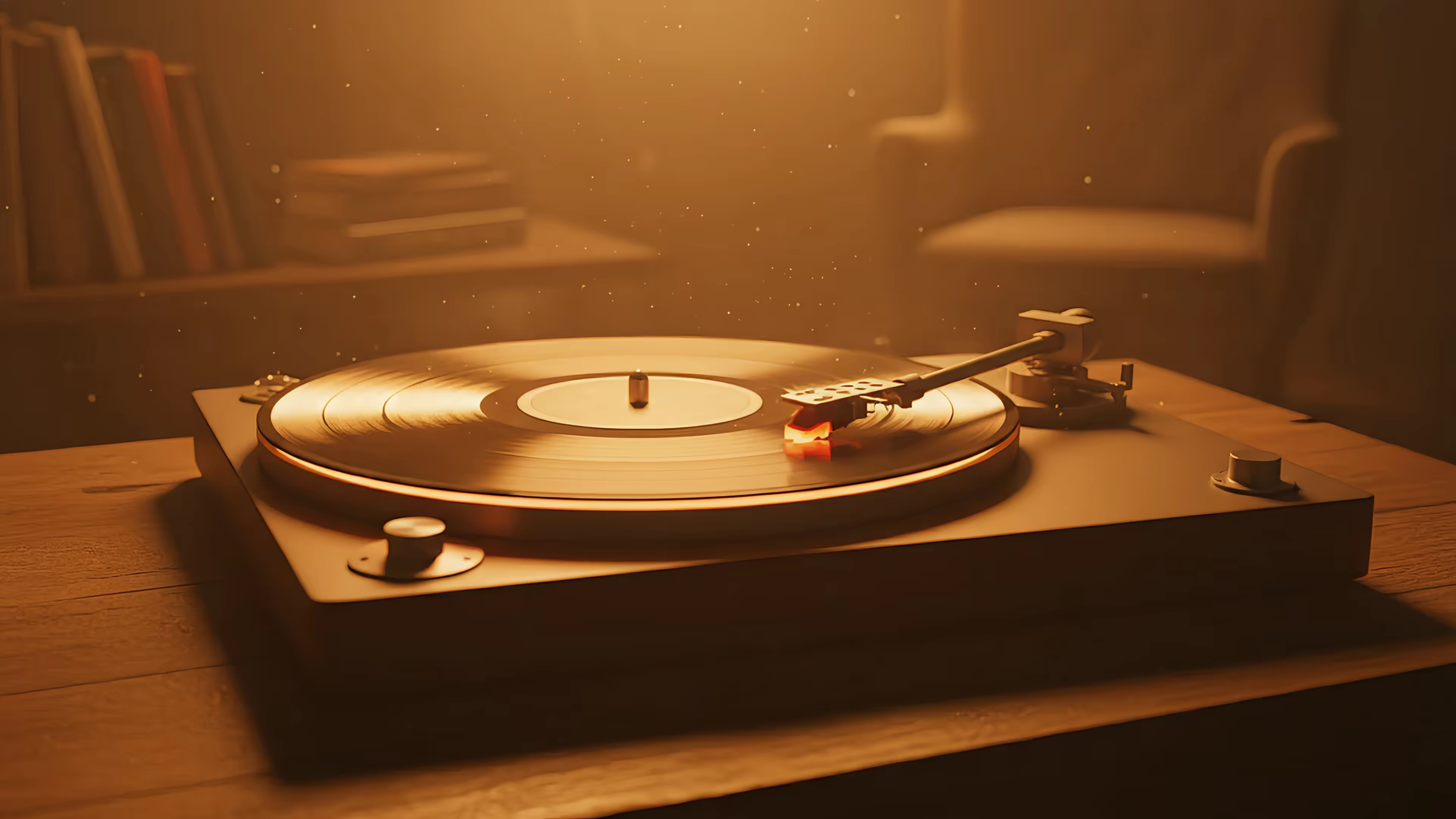
Ambient Music Genre: A Listener's Guide
A calm screen and a calm soundtrack do a funny little duet. One sits there looking like a fireplace that pays rent, the other hums along while you answer email, pretend to be decisive, and open the same tab three times because the first two were obviously not the right ones. That's the appeal of the ambient music genre—it doesn't elbow its way into the room, it changes the room's temperature and then leaves the thermostat alone.

Entering the Ambient Music Genre
The easiest way to understand ambient music is to start with the room, not the rules. You're at your Mac, the email pile is acting smug, and a fireplace wallpaper is doing more emotional labor than your actual calendar. Ambient fits that moment because it behaves like visual texture, a soft layer in the background, something closer to light through frosted glass than a song that grabs your sleeve.
That doesn't mean it's empty. The better comparison is wallpaper, not decoration in the flimsy sense, but surface with mood. A good ambient track, like a good looping scene on your screen, gives your brain something continuous to rest on without demanding you decode every second of it.
A quiet genre with a surprisingly loud footprint
Ambient's roots are usually traced back to the 1970s, but its modern life is much easier to measure than its early art-gallery beginnings. Ambient gained widespread recognition on YouTube from the early 2010s onward, with uploads often lasting 1 to 8 hours and drawing millions of views. That long-form format matters because it matches how people use ambient now, as continuous atmosphere rather than tidy little song units.
The release side tells the same story in a more spreadsheet-shaped outfit. Chosic's genre chart shows 16,352 ambient releases total, with 10,689 of them in the 2020s alone, including 3,705 in 2023 and 2,302 in 2024. That means more than 65% of the listed releases on that chart come from the current decade.
Practical rule: if a genre keeps showing up in long-form uploads, streaming playlists, and endless release lists, it's no longer a museum label. It's part of daily listening.
Why the genre feels modern even when it isn't
That shift also explains why ambient shows up everywhere now, from cafés to workspaces to streaming playlists. NPR reported in 2024 that a market research firm valued the broader background-music industry at $1.5 billion, and that Spotify now has a dedicated ambient and mood-music genre with dozens of playlist options. Spotify's Deep Focus playlist had 4.8 million likes, while Ambient Relaxation had 1.2 million likes.
That's why the genre feels less like an underground secret and more like a mainstream utility with taste. It's still art, but it's art that knows you've got tabs open.
A Short History of Ambient Music
The history of ambient music is basically the story of a sound that learned to move into the center of modern listening by staying on the edge. The genre's early reputation came from experimental circles, but by the streaming era it had become a normal part of how people shape mood, concentration, and downtime. The leap from niche to platform staple didn't happen because ambient got louder. It happened because listeners started wanting music that could fill space without flattening it.
One useful clue is the way long-form ambient circulated online. Early YouTube uploads often ran for hours, which made sense for a genre built around continuity rather than verse-chorus punctuation. That format taught listeners to treat ambient as atmosphere first and object second. The genre's digital life became a little like a looping wallpaper, less about where one loop ends and the next begins, more about how the whole thing feels while it keeps going.
From experimental edge to platform category
The 1970s are the usual starting point for ambient's origin story, but the present-day version looks very different from those first experiments. Instead of tape loops sitting in tiny art-music corners, ambient now lives inside streaming interfaces, recommendation systems, and background playlists. The genre has become easy to find because services know people use it functionally, to work, study, relax, and generally keep the room from becoming mentally hostile.
That's also why modern ambient pairs so neatly with lofi aesthetics. Lofi and ambient don't mean the same thing, but they share a taste for texture, softness, and low-friction mood. If you want the visual equivalent of a long, steady drone, a lofi wall on your Mac is a very reasonable place to start.
What the numbers say about the genre's growth
The release chart tells a blunt story. With 10,689 ambient releases in the 2020s, the genre isn't merely surviving online, it's being produced at a pace that would've looked absurd in its early days. The current decade accounts for more than 65% of the chart's total listed releases, which is a strong sign that ambient has shifted into a prolific digital category.
Useful way to think about it: the genre's early history was about breaking away from song form. Its recent history is about being everywhere that people need sustained attention, or sustained non-attention, without making a fuss about it.
That's the broad arc. A 1970s experiment became a streaming-era utility, and then a utility became a culture with taste, playlists, and far too many hours of very polite music.
Core Sounds of Ambient Music
Ambient music is built by subtracting things most songs treat as essential. It de-emphasizes meter, melody, and song form, and instead leans on timbre, sustained texture, and spatial effects. A production guide notes that pure ambient often has no detectable tempo, while beatless or near-beatless arrangements rely heavily on reverb and delay to create a sense of acoustic space.
That's the main trick. Ambient doesn't ask, "What's the hook?" It asks, "What's the air made of?" Pads, drones, slow filters, and long envelopes do the work that a chorus would normally do in other genres. The interest comes from gradual change, not obvious events.
Sound design first, song structure second
If you're trying to identify ambient by ear, stop looking for the usual song landmarks. There may be no drum kit, no strong meter, and no neat little payoff at the end of eight bars. Instead, the track can feel like a room changing color while you're still standing in it.
A helpful visual analogy is wallpaper. A busy wallpaper repeats a pattern loudly, while a subtle one changes how the whole room feels without drawing attention to a single motif. Ambient works the same way. It's less like a neon sign and more like light passing over fabric, where the texture matters more than the outline.
A lot of beginners hear that and assume "slow" is the same thing as ambient. It isn't. Slow music can still be very directional, full of beat and chord drama. Ambient usually strips away that pressure, so the listener can float in the sound rather than march through it.
Practical rule: if you can tap a firm backbeat to the track, you may be in neighboring territory, not ambient proper.
Why texture matters more than hooks
Ambient pieces often change through filtering, automation, and timbral drift. Those are not glamorous words, but they're the mechanics that make the genre breathe. A pad can widen, a drone can darken, a reverb tail can blur into the next layer, and suddenly the piece feels alive without ever behaving like a pop song.
This is also why ambient can pair so well with a static desktop or a slow loop. A wallpaper with depth and motion gives your eye the same kind of steady variation that a good ambient piece gives your ear. The screen stays calm, but it isn't dead. Neither is the music.
Why the absence of percussion changes the listening experience
A useful mechanical fact is that ambient often minimizes or removes beat and percussion, replacing them with pads, sustained sounds, drones, and slow harmonic progressions. Many ambient pieces have no percussion at all, and when a pulse exists, it's often very slow or only implied.
That absence is not a defect. It's the point. Without percussion pushing time forward, the listener can settle into the texture instead of tracking the count. It's the audio equivalent of a wallpaper that doesn't wink at you every six seconds.
Subgenres and Albums to Hear
Ambient gets less confusing once you stop treating it like a single monolith and start hearing the family resemblance among its branches. Some pieces are all cloud and no floor, some add a faint pulse, and some drift toward cinematic or electronic territory. The labels help, but only if you use them as clues rather than legal contracts.
A listening menu that keeps its shoes off
Drone is the most stripped-back branch, where sustained tones and long spans matter more than movement. Space ambient leans on open harmonics, cosmic drift, and that "somewhere far beyond the accounting department" feeling. Lofi-adjacent ambient keeps the softness but borrows a little grit or rhythm from lo-fi scenes, which is why it overlaps so naturally with cozy, textured visuals.
Ambient house adds a gentle pulse without turning into a club track. Cinematic ambient stretches mood across longer narrative shapes, which is why it shows up so often in film and game soundtracks. If you want a visual partner for that feeling, the right wallpaper depends on whether you hear the music as city glow or deep vacuum.
A useful starting point is Brian Eno's Music for Airports, which helped define ambient as music that can sit in a public space without bullying the air around it. Aphex Twin's Selected Ambient Works Volume II pushed the genre toward more haunting, textural territory. Steve Roach's Structures from Silence is another clean example of slow expansion over long duration. Those records don't sound identical, but they all treat atmosphere as the main event.
Where newer listening habits fit
The genre's modern afterlife lives on platforms and in adjacent media. A lot of ambient now appears in long-form uploads, streaming playlists, and visual projects that want music to act like environment. That's where the pairing of sound and visual space becomes interesting—not just background music, but a full sensory mood.
Good listening habit: pick one album, not a stack of samples. Ambient reveals itself over time, and the wrong shuffle habit can make everything sound like a politely haunted waiting room.
If your favorite ambient record feels like a room, the right wallpaper usually feels like the same room after someone dimmed the lights and stopped talking.
Where Ambient Music Works Best
Ambient works best where attention needs to stay soft around the edges. The genre's extended durations and minimal harmonic motion reduce cognitive load, which is why it fits study sessions, sound design, film scoring, and any task that needs a calm background without constant interruption. That doesn't mean it only works for work. It means it supports tasks that benefit from steady mood rather than lyrical instruction.
That's also why ambient and sleep advice keep bumping into each other in the wild. A calm environment helps people settle, and the sound design of ambient often contributes to that same sense of low-friction space.
Match the task to the texture
Study is the obvious use case, but it's not the only one. Film composers use ambient textures to hold emotion without spelling it out in neon. Sound designers use it to create depth and continuity. Even a casual listening session benefits when the music doesn't demand a handshake every 20 seconds.
For Mac users, that same logic applies to the screen. A still image can be enough for some moments, but a living background is better when you want the desk to feel inhabited without becoming distracting.
A few practical pairings
Study and reading work well with very sparse ambient, especially the kind that avoids sharp transients. Late-night coding or editing benefits from deeper drones or soft cinematic pieces. Tidying the apartment while pretending it's a noble ritual usually calls for something with a bit more texture, because otherwise the dishwasher starts sounding philosophical.
A simple rule helps here.
Practical rule: if the task needs clarity, choose ambient that stays open and low-detail. If the task needs atmosphere, choose ambient that carries more texture and harmonic color.
That's the larger value of the genre. It adapts to the room you're already in, then makes the room feel intentionally designed instead of accidentally occupied.
Ambient Versus Lofi Drone Chillout
Ambient gets lumped together with lofi, drone, and chillout because all four can be polite enough not to ruin a conversation. The difference is in what each genre leaves in and what it removes. Ambient usually minimizes or removes beat and percussion, while the neighboring styles keep more obvious rhythmic markers, more looped groove, or more static sustain depending on the lane.
That distinction matters if you're trying to label what you hear without lying to yourself.
How the labels separate
Lofi often keeps a slow beat, a little hiss, and a sense of human imperfection. It feels like a desk lamp and a notebook, not a fog bank. The lofi aesthetic pairs that sound with visuals that have warmth and texture—hand-drawn details, soft edges, maybe a cat in the corner.
Drone is usually more static, more sustained, and less interested in motion than in pressure and overtones. It can feel closer to holding a single color under a lamp for a long time. Chillout tends to be more rhythmic and more obviously scene-setting, with a gentler pulse than club music but more structure than ambient.
A quick decision frame
If you hear a track and can easily count a beat, you're probably not in pure ambient territory. If the piece feels like it's hovering, you may be closer. If it feels like a soft groove with dust on the edges, lofi or chillout may be the better label. None of this is moral law, of course. Genres are not border police. They're just useful boxes for people who like sorting sound the way other people sort spices.
Ambient's purpose is often to create calm, contemplative, or immersive space. Lofi can do that too, but it usually does it with a little more rhythmic wink. Drone tends to flatten time even further. Chillout softens the edges of beat-driven listening without removing the beat entirely.
Why honesty about the label helps
That honesty matters because the listening experience changes when the label is right. Someone who wants ambient for focus may find lofi's beat just noticeable enough to be distracting. Someone who wants a little groove may find ambient too shapeless. Matching the label to the sound keeps the promise honest, which is a rare and pleasant thing in any medium.
Practical rule: if the music feels like atmosphere first, label it ambient. If the beat is part of the appeal, it's probably one of the neighbors.
The same logic works visually. A neon wallpaper says something different from a fireplace scene, and a lofi train window says something different from a star field. The categories are close, but they don't all tell the same story.
Playlists and Wallpapers for Ambient Mood
If you want a listening place to start, Spotify's Deep Focus and Ambient Relaxation playlists are already doing the obvious job. Those playlists have massive listener interest, which makes sense because they're built for exactly the kind of low-friction background ambient is good at providing. That's a practical entry point, not a sacred text.
For the visual side, start with matching moods rather than matching file types. A fireplace wallpaper brings warmth and flicker without chaos. A space wallpaper gives you the same long-view feeling ambient music loves. A lofi wallpaper works when the sound has a little grain and the room needs a softer personality.
A screen and speaker duo that behaves itself
The best pairings are the ones that don't argue with each other. Ambient audio and a calm live wallpaper can share the same job, which is to make the Mac feel occupied without becoming noisy. That's especially nice when your desk is doing the emotional equivalent of a beige cardigan.
If you want your Mac lock screen, desktop, and screen saver to match the same calm energy you're hearing, gifPaper sets live 4K looping wallpapers without the hacky overlay nonsense. Visit gifPaper and try a wallpaper that doesn't shout over your music. There's a 7-day free trial and a $4.99 one-time purchase after that.