How Ice Crystal Formation Actually Works
You wake up, glance at the window, and the glass has turned into a tiny arctic crime scene. A feathered frost fern has marched across the pane overnight, your glove picked up a snow crystal, and now you're holding a structure that looks like it was designed by a patient mathematician with excellent taste in cold weather.
That little sparkly shape isn't a frozen raindrop. It's ice crystal formation, which is a much more interesting phrase than it sounds. Water vapor, temperature, humidity, and microscopic airborne specks all get involved, then the atmosphere starts arranging molecules like it's building a cathedral with very unreliable contractors.

What Ice Crystal Formation Really Means
A snowflake on your sleeve and frost on a car window look different because they are different, but they're both the result of the same basic rule. Ice crystals grow molecule by molecule from water vapor, not from a little ice nugget falling out of the sky fully formed like a frozen croissant. Caltech's Physics of Snow Crystals describes the process as vapor attaching to a tiny nucleus, usually a dust grain, and growing when humidity is above 100%. Caltech's snow crystal notes make that plain enough for a human being to follow before coffee.
The important part is that the atmosphere doesn't build every crystal the same way. Temperature, humidity, and the particles floating around in the air decide whether you get a lacy snowflake, a plate, a column, or a crust of rime that looks like the object got dipped in powdered ice and forgotten there.
Two jobs at once
One job is the physics, how crystals begin and keep growing. The other is the visible world that physics creates, which is the bit people photograph with gloved hands and then post like they've discovered winter personally.
Practical rule: if the air is carrying the right moisture and the surface or cloud is cold enough, ice does not politely ask permission. It starts arranging itself.
Nucleation and How Ice Crystals Get Started
Ice needs a start point, and the start point depends on how cold things are. Between 0°C and about -36°C, liquid water usually needs an ice nucleus, such as dust, to freeze by heterogeneous nucleation. Below about -36°C, pure water can freeze by homogeneous nucleation without needing that trigger, which is why very cold upper clouds and polar air behave so differently from a damp Tuesday near freezing. University of Manchester cloud physics lays out that split clearly.
The cold threshold that changes the rules
There's another milestone that matters in atmospheric physics, roughly -40°C. Educational meteorology sources describe it as the point where water in the atmosphere can crystallize without needing an ice nucleus, while above that, freezing usually needs a particle to get things started. LibreTexts meteorology notes frame this as the transition from nucleation-limited freezing to spontaneous crystallization.
That's why dust, soot, and aerosol loading matter so much. More particles in the air can mean more places for ice to begin, which changes whether a cloud stays supercooled or starts making ice crystals sooner. The cloud is still the same cloud, but the microscopic backstage crew is now yelling different instructions.
Supercooled water is the weird part
Water can stay liquid below 0°C, which feels rude until you remember water has never asked for our approval. Those supercooled droplets are the ones that make mixed-phase clouds interesting, because they sit there waiting for a trigger. Once one appears, the whole cloud microphysics can shift.
Useful mental shortcut: cold alone doesn't guarantee ice. Cold plus a nucleus, or cold enough conditions for spontaneous freezing, is what flips the switch.
Temperature and Humidity Control Crystal Shape
Once a crystal starts, the next question is not "will it grow?" but "what kind of weirdo will it become?" Temperature sets the broad habit, while humidity, especially supersaturation, decides how elaborate the growth gets. That's why the old Nakaya diagram is such a beloved cheat sheet in cloud physics, it maps temperature and moisture into the shapes people see.
Shape is not random
At around -20°C, a separate atmospheric study found that, near water saturation, cloud ice-habit distributions are roughly 65%–70% polycrystals and 30%–35% plates. The National Weather Service winter precipitation page includes that behavior alongside the usual temperature thresholds, and it's a good reminder that the crystal habit is predictable rather than mystical. Ice does not roll dice. It follows the thermodynamics like a bureaucrat with a ruler.
A plate and a column are both ice, but they don't look remotely alike. A plate reads like a thin geometric tile, while a column looks like a tiny pillar. Add more supersaturation and the growth can get more ornate, which is how you end up with those lacy dendrites that look like somebody taught a snowflake to do calligraphy.
Why the same cloud makes different shapes
A crystal drifting through slightly different layers of air may encounter changing temperature and humidity on the way down. That means the shape can shift during growth, which is one reason real snow crystals look so individual. The atmosphere is not a factory line, it's more like a drafty workshop with the windows open.
Short version: temperature chooses the family resemblance, humidity chooses how flamboyant the result gets.
The Wegener–Bergeron–Findeisen Process
Mixed-phase clouds hold both supercooled droplets and ice crystals, and that mix sets up a very lopsided growth pattern. The saturation vapor pressure over ice is lower than over supercooled water, so water vapor prefers the ice surface and deposits there first. That is the Wegener–Bergeron–Findeisen process, and it explains why a cloud with only a little ice can start behaving as if the ice has taken control.
Why droplets shrink while crystals grow
As vapor drifts toward the ice, the droplets lose material while the crystals gain it. The result is a steady imbalance, with ice growing faster than its starting size would suggest and precipitation forming more readily in colder clouds. Once ice appears, it does not just sit there looking decorative, it starts reshaping the cloud's entire microphysics. The process summary states the mechanism directly.
Cold clouds can turn productive quickly for that reason. You do not need a cloud packed full of ice to get strong growth, only enough ice to tip vapor transport in its favor. The atmosphere then behaves like a one-way supply line aimed at the crystals, while the droplets run short on material.
Two linked stages
Ice crystal science often gets described as crystallization and recrystallization. A recent review also breaks freezing into pre-cooling, phase transformation, and tempering, which is a tidy reminder that the story does not end when the first crystal appears. The review on freezing stages makes that sequence explicit.
Once temperature fluctuations enter the picture, recrystallization starts reshaping what has already formed. That matters when the air or the surface keeps changing its mind, because the crystal you started with is not always the crystal you end up seeing.
Snowflakes, Frost, and Rime in Practice
Snowflakes, frost, and rime are the same physics wearing three different coats. The difference is where the ice gets to grow. Snowflakes form in the air as vapor attaches to a nucleus, usually a dust grain, while they move through layers of changing temperature and humidity. Frost grows directly on a cold surface when vapor deposits there. Rime happens when supercooled droplets hit a cold object and freeze on contact, leaving a rough, opaque crust that looks like winter attacked the branch with a sugar shaker.
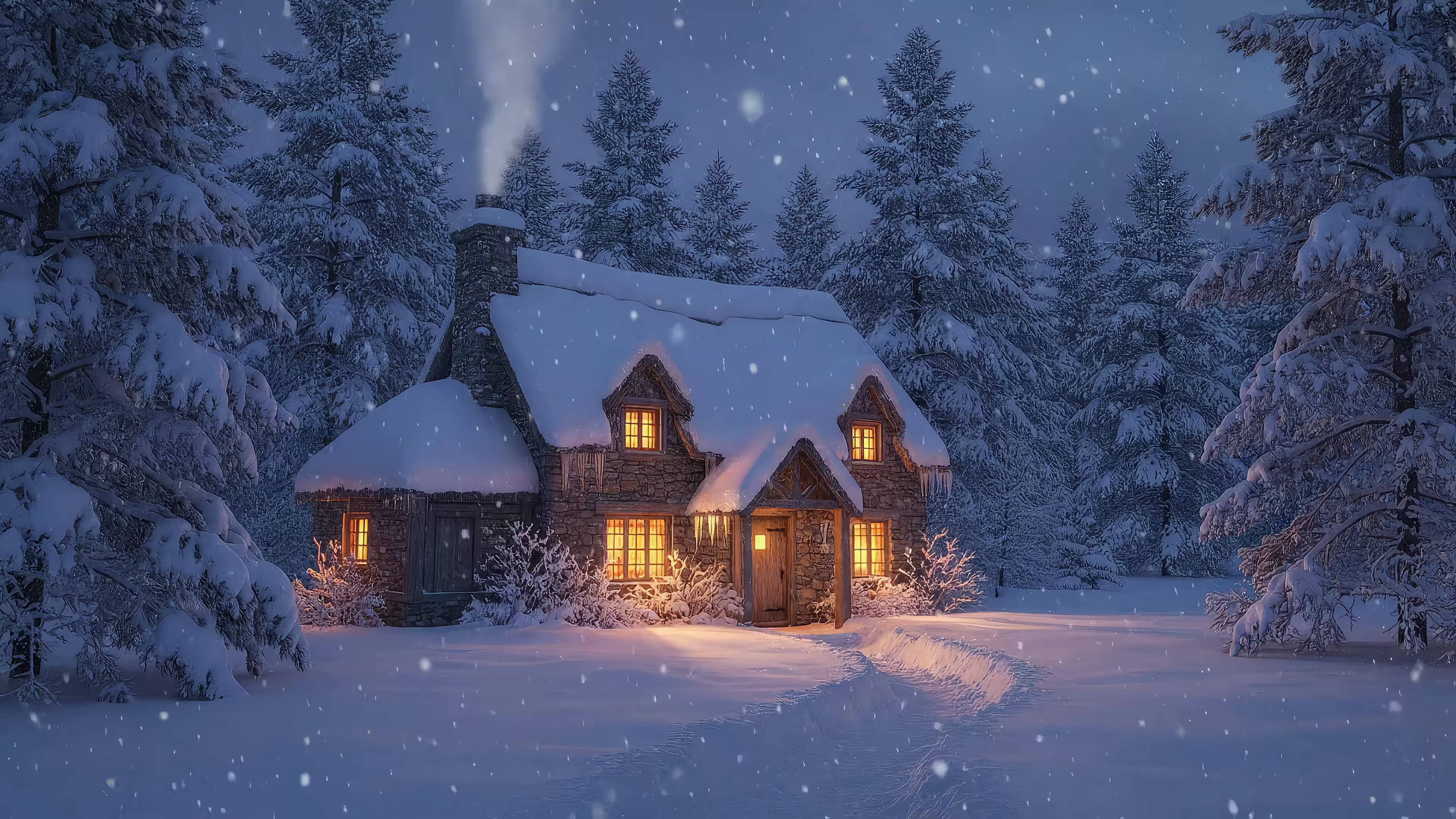
A snowflake has room to branch and rebranch while it falls, so it can develop symmetry and fine detail. Frost grows on a surface, so it spreads into feathers, ferns, and other patterns that look like the window is trying to do botanical cosplay. The cabin on a snowy screen can look just as deliberate. A winter cabin wallpaper for anyone who likes their screen to look like it has mastered the art of being cold on purpose.
Three cases, three outcomes
Rime is the blunt one. It forms when fog or freezing spray hits a cold object and freezes immediately, so the result is dense, rough, and not remotely shy about it. Snow is the delicate version, and frost is the artist who only works on glass.
- Snowflakes: grow through vapor in the air, so the crystal can branch as conditions change.
- Frost: forms by direct deposition onto a cold surface, which is why windows get those filigreed patterns.
- Rime: forms when supercooled droplets freeze on impact, which gives the surface an opaque, lumpy coating.
The visual gap between these three is huge, but the underlying rule is the same. Temperature, humidity, and nucleation conditions choose the final look. Small changes in the air can push ice toward six-armed dendrites, plate polycrystals, or the rough crust of rime. That is why winter photos can look so different even when the scene seems almost unchanged.

Why It Matters Beyond Looking Pretty
Aviation cares because supercooled droplets hitting a wing and freezing on contact can change how the wing behaves. Ice detectors and de-icing systems exist for a reason, which is a polite way of saying pilots would rather not let physics improvise on the fuselage.
Weather forecasting also depends on this. The difference between snow, sleet, freezing rain, and graupel comes down to where crystals form and what they pass through before reaching the ground. If the atmosphere builds ice in one layer and melts or refreezes it in another, the result changes. The sky is doing compound interest, but with water.
Cryobiology uses the same basic principles for a much more delicate job. When scientists freeze cells, tissues, or organs, recrystallization can damage texture and structure, so the distinction between initial crystallization and later crystal growth is not academic at all. A liver is not impressed by your clever terminology, it just wants to survive the freezer.
Photographing Ice Crystals and Turning Them Into Wallpapers
A strong ice crystal photo begins with a subject that is still, cold, and not yet melting under your attention. Hoar frost on plants, window frost on a freezing morning, and rime on trees at high elevation are some of the easiest places to find real structure. A real macro lens helps far more than phone "macro mode," which usually behaves like a close-up with commitment issues.
Capture the shape before it vanishes
Use a flashlight or speedlight from the side so the crystal catches raking light. Side light reveals edges, branches, and tiny ridges that flat lighting hides. Work quickly, because the crystal is already changing, and sometimes sublimating, while you are still adjusting focus like a Victorian scientist who misplaced his spectacles.
- Choose a still subject: frost on glass, hoar frost on stems, or rime on branches.
- Use angled light: side lighting makes ridges and branches visible.
- Move fast: the crystal will not wait for your tripod to become spiritually ready.
That same detail is what makes these images work as wallpapers. A single close-up crystal is striking, but a looping winter scene on a Mac screen can keep that texture alive in a way a still photo cannot. Snow falling, frost glittering, or a snowy cabin scene gives the eye something to rest on, then notice again a second later, which is a neat trick for a background that is supposed to stay in the background.
For animated setups, the snow animated backgrounds guide shows how to make the motion feel deliberate instead of like a screensaver from a forgotten office lobby.

Where the Visuals Meet the Physics and FAQ
Ice crystals begin when vapor finds a nucleus or the temperature drops low enough, then grow into shapes chosen by temperature and humidity. That's why one cold morning gives you lacy dendrites, another gives you plates or columns, and a third gives you rime that looks like the branch lost a fight with a fog machine. The science is picky, but the results are generous.
FAQ
Can two snowflakes really be identical? In practice, no. The growth conditions keep changing as the crystal falls, and tiny differences in temperature, humidity, and path through the air change the final shape.
Why does frost form on the inside of windows? The inner glass surface can drop below the frost point, so water vapor from the room deposits there directly as ice. That's why the window gets a delicate mess while the radiator sits there looking smug.
Why do ice crystals matter in food science? Because recrystallization changes texture. If crystals grow too large in frozen desserts, the result turns coarse instead of smooth, which is the culinary equivalent of a polite shrug turning into gravel.
If the winter visuals here scratched the right part of your brain, the winter wallpaper collection has a lot more snow, frost, and cabin energy to browse, and the guide to live wallpapers on Mac shows how to put that look on your own screen.
gifPaper turns looping winter scenes into a lock screen and desktop that feel alive, which is a nicer way to wake up than staring at a blank wall of pixels. If you want your Mac to borrow a little of this ice crystal mood, visit gifPaper and see what's in the gallery.