
28 Day Fast: A Guide to the Risks, Benefits, and Sanity
Meta description: Considering a 28 day fast? Here's the blunt, practical guide to the risks, likely outcomes, safer alternatives, and how to keep your sanity.
You're probably here in a very specific mood.
Maybe you had a rough month, stepped on a scale you didn't enjoy, looked in the mirror with the solemn intensity of a Victorian orphan, and decided the answer might be to do something extreme. A 28 day fast has that dramatic appeal. It feels clean, decisive, almost mythic. No meal prep. No calorie math. Just you, water, and an argument with biology.
I understand why that sounds seductive. A long fast promises a reset button when most health advice feels like unpaid clerical work. But a month without food is not a tidy little reset. It's a major physiological stressor, a serious mental test, and for some people, a highly unsafe idea.
There's also a practical truth people skip. The hard part isn't only what happens to your body. It's what happens to your mind when your days become structured around not eating, avoiding triggers, managing energy, and trying not to lose the plot because someone near you opened a bag of chips.
So You're Thinking About Not Eating for a Month
It usually starts in a familiar way. Late at night. Too much reading. Too many heroic stories from strangers on the internet who claim they emerged from a long fast purified, focused, and somehow lit from within like a tasteful lamp.
Then your brain does that dangerous little trick where it turns an extreme act into a neat personality arc. Not eating for a month stops sounding like starvation-adjacent behavior and starts sounding like discipline. A cleanse. A reset. A biological monastery with worse snacks, because there are no snacks.
The appeal is real. A 28 day fast seems simpler than moderation. "Eat sensibly for a long time" is profoundly unglamorous. "Do one giant difficult thing" has theater. It also has consequences.
Most people aren't drawn to a month-long fast because it's convenient. They're drawn to it because they want a fast answer to a slow problem.
That doesn't make you foolish. It makes you human. People reach for dramatic solutions when they're tired of half-results, mixed messages, and health advice that sounds like it was written by a polite refrigerator.
There's also the mental side. Long fasting narrows your world. Meals disappear, but the thoughts don't. Food becomes louder precisely because you're trying to silence it. Routine matters more. Environment matters more. Even the stuff in your visual field matters more when your patience is thin and your brain is bargaining. If you're already trying to make your work setup feel calmer, something like lofi study music for focus makes more sense than pretending mindset has nothing to do with adherence.
A month-long fast is not a casual self-improvement project. It's an extreme intervention. If you're going to consider it, you need the unromantic version.
What a 28-Day Fast Actually Is (and Is Not)
The phrase 28 day fast gets tossed around with magnificent sloppiness. That's a problem, because people use it to mean completely different things.
The definition that matters
A true 28 day fast means prolonged fasting. In plain English, that's a continuous stretch of severe calorie restriction or total food abstinence lasting for days or weeks. The strictest version is a water-only fast. That means water, and if the person is being careful, electrolyte management too. Not smoothies. Not "just a little broth." Not "mostly fasting except for the almonds."
Other versions exist, but they are not the same thing:
- Water-only fasting: The harsh, literal version. No calories.
- Juice fasting: Often sold as cleansing, but it still includes calories and doesn't function like a true zero-calorie fast.
- Modified fasting: Low-calorie protocols designed to imitate some fasting effects without complete abstinence.
If you want a broader orientation to different fasting styles, this overview of natural approaches to wellness fasting is useful because it lays out the categories in a readable way, rather than throwing every fasting idea into one mystical blender.
What it is not
A lot of mainstream articles blur prolonged fasting with intermittent fasting. That's how readers end up thinking "28-day fasting plan" means "I followed 16:8 for four weeks," when that is completely different from not eating for 28 straight days.
According to Healthline's guide to alternate-day fasting, much of the existing coverage mixes up long fasting with intermittent fasting, and mainstream guidance usually frames 28-day plans as time-restricted eating or staggered fasting patterns, not continuous food abstinence. The same guidance notes that intermittent fasting can produce weight loss, but it's often not superior to traditional daily calorie restriction.
That distinction matters more than people think.
| Approach | What it looks like | Risk profile |
|---|---|---|
| True prolonged fast | Continuous food abstinence for many days | High. Medical concerns become central |
| Intermittent fasting | Eating windows or alternating fasting days | Lower. Still requires planning |
| Calorie restriction | Eating daily, but less | Often less dramatic, often more livable |
If someone says they did a "28 day fast," the first question isn't "How did it go?" It's "What do you mean by fast?"
Without that clarification, people compare apples to no apples at all.
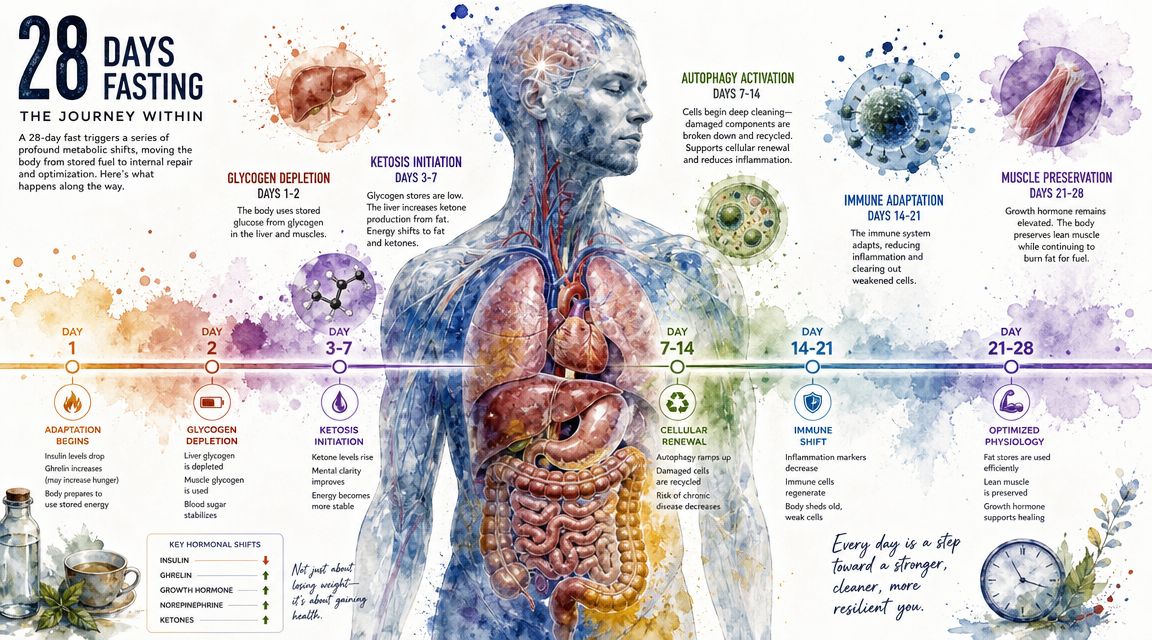
The Physiological Timeline: What Happens Inside Your Body
The first thing to know is that the scale becomes a chaos goblin during a prolonged fast. It reports change, but not always the kind you think.
Early days and the dramatic drop
At the beginning, the body burns through glycogen, its stored carbohydrate. That matters because glycogen is stored with a lot of water. Each gram of glycogen is stored with about 3 to 4 grams of water, which is why body weight can fall quickly at first, according to BodySpec's review of fasting physiology.
That same source cites a 2024 fasting study reporting an average loss of about 5.7 kg in one week, with roughly 65% to 75% initially classified as lean mass. The important catch is that much of that early "lean mass" change reflects water and glycogen, not pure contractile muscle tissue.
So yes, the number on the scale may plunge. No, that does not mean your body just politely melted a clean block of body fat.
The metabolic handoff
After glycogen drops, the body shifts toward ketosis. This is the point where fasting narratives often become weirdly spiritual. Some people report steadier hunger, a different mental state, or less obsession with food than they had in the opening stretch. Others feel flat, cold, distracted, or intermittently furious at the existence of crackers.
A useful human study on complete fasting found that adults maintained physiological homeostasis over 10 days with no major side effects, and that energy supply reached a new stable balance after about 3 to 6 days, driven by accelerated fat decomposition and reduced resting energy expenditure, according to the study on complete fasting and metabolic adaptation.
That doesn't mean "all good after day six." It means the body adapts to stress in a measurable way. Adaptation is not the same as safety.
Practical rule: Early weight loss in a long fast is noisy. Treat it as a mix of water shifts, glycogen depletion, and tissue change, not a neat scoreboard of fat loss.
Later on, the problem is less theatrical and more serious. You're asking the body to keep functioning while it takes energy from stored reserves and reduces expenditure where it can. That may feel sustainable for a while. It is still a strain.
Aesthetic calm helps more than people admit during long, boring, uncomfortable stretches. The environment around you becomes louder when your energy is thin. A quiet desktop and a live looping wallpaper costs nothing—literally, gifPaper's trial is free—and it actually helps.
Potential Benefits Versus Very Real Risks
The sales pitch for prolonged fasting is always cleaner than what occurs in practice. So let's split this into what people hope for, and what the evidence warns about.

What people are hoping to get
The main attraction is weight loss. A clinical review of water-only fasting found that protocols lasting 5 to 20 days typically produced 2% to 10% weight loss, with longer fasts in that studied range tending to produce the larger losses. In that same review, about two-thirds of the weight lost was lean mass and about one-third was fat mass, as reported in the clinical review of prolonged water-only fasting.
That's the part fasting evangelists tend to mumble through. The scale moves. The composition of that movement is not especially flattering.
People also talk about autophagy, "metabolic reset," and a cleaner internal state. Some of those ideas have plausible mechanisms behind them. What they do not have is a free pass from trade-offs. A biological process can be interesting and still not justify a month-long fast for the average person.
What can go wrong
Here's the rough ledger:
- Lean tissue loss: The review above found a large share of lost weight came from lean mass, not just fat.
- Safety limitations: That same review described prolonged water fasting as only moderately safe even within the 5 to 20 day window studied.
- Electrolyte management: In the complete-fasting study, the authors specifically noted that sodium chloride should be considered during extended fasting. That is not decorative advice. Electrolytes become operationally important when a fast extends beyond a few days.
- Refeeding danger: Ending a long fast badly can be one of the riskiest parts of the whole process.
A lot of readers who care about fasting also care about body composition. If preserving muscle matters to you, the logic transfers beyond fasting too. This guide on strategies for preserving muscle on Ozempic is useful because it focuses on the same core concern: rapid weight change isn't a win if lean tissue pays the bill.
The crude version is this. "I lost weight" and "I improved my body composition" are not automatically the same sentence.
And then there's the lived experience. Long fasting can make ordinary tasks feel oddly expensive. Planning, concentration, training, social life, and sleep all get dragged into the conversation. If you've ever tried to work while underfed, you already know the brain doesn't always become a laser. Sometimes it becomes a sulking Victorian child.
When people need help settling their attention without opening the pantry out of boredom, something as low-tech as a calmer ritual matters. For some, that's music. If you need a gentle version of that, ambient music for studying is a better coping mechanism than treating your kitchen like a final boss arena.
Who Should Absolutely Never Attempt This
Some people should not attempt a 28 day fast at all, outside direct medical supervision, and in many cases not even then unless there is a compelling clinical reason.
The obvious no list
Public-facing fasting guidance consistently flags certain groups as poor candidates for fasting or as people who should only consider it with medical oversight:
- Pregnant or breastfeeding people
- Children and adolescents
- People who are underweight
- Anyone with a history of eating disorders

If that's you, this isn't a challenge to grit your teeth through. It's a bad fit.
The less obvious no list
There's another category that gets less attention. People living high-stress, high-friction lives often assume they can just "be disciplined" and make a prolonged fast work through force of personality. That's optimistic in the same way carrying too many grocery bags in one trip is optimistic. Noble. Familiar. Sometimes disastrous.
Comparative research on fasting found that different regimens can produce about 1% to 13% body-weight reduction over 2 to 52 weeks, but there was no statistically significant difference between fasting styles in that meta-analysis, according to the comparative review of fasting regimens and adherence. The practical implication is that the biggest issue may not be finding the supposedly perfect fast. It may be finding something you can stick with without wrecking your week.
That matters for busy people more than abstract theory does.
| Situation | Why a 28 day fast gets harder |
|---|---|
| Demanding job or study load | Focus and mood become less predictable |
| Family or caregiving duties | You don't control meals, timing, or stress |
| History of rigid dieting | Fasting can intensify unhelpful patterns |
| Poor sleep | Hunger, irritability, and decision fatigue often feel worse |
If daily life already feels like a balancing act, adding prolonged fasting doesn't make you more disciplined. It gives you one more unstable object to juggle.
Mental strain is not a side issue here. It's central. A month-long fast changes how often you think about food, how social situations feel, and how much friction ordinary life generates. For a lot of people, reducing stimulation and making the environment calmer is more useful than adding another hard rule. If what you need is visual quiet, something simple like a looping nature wallpaper scratches that itch without asking your endocrine system to perform acrobatics.
Safer Alternatives and How to End a Fast
The better question often isn't "Can I survive a 28 day fast?" It's "What gets me a meaningful result with less collateral damage?"
Better options than the month-long siege
A few routes make far more sense:
- Intermittent fasting: If you like structure, this gives you structure without asking for total abstinence. For a plain-English overview, this article with expert advice on intermittent fasting is a decent starting point.
- Shorter fasting periods: Some people tolerate shorter fasts better and can recover from them more sensibly.
- Ordinary calorie control: Not glamorous. Frequently effective. Annoyingly hard to market because it lacks wizard robes.
If your real goal is health, routine beats drama more often than drama fans would like to admit.
Refeeding is not the victory lap
If you do any fast lasting beyond a short window, refeeding deserves as much caution as the fast itself. The instinct to celebrate with a large meal is exactly the instinct to distrust.
Keep the principle simple:
- Start small
- Choose easy-to-tolerate foods
- Increase intake gradually
- Do not treat the end of the fast like an eating contest
That sounds obvious, but fasting makes people weird. After deprivation, the brain is not famous for moderation.
A calmer routine is often more useful than a harsher protocol. If you want a challenge that doesn't involve spending a month negotiating with broth, a 6-week fitness challenge is already more grounded in actual life.
If your environment affects your sanity, and during any diet or fasting phase it usually does, gifPaper is a pleasantly unnecessary thing that becomes surprisingly necessary once you've tried it. It turns your Mac lock screen, desktop, and screen saver into smoothly looping live wallpapers using Apple's native Aerial format. Cozy fireplaces, neon rain, quiet nature scenes, lofi corners for staring into the middle distance. About 150+ wallpapers are available to browse, there's a 7-day free trial with no credit card, it's $4.99 as a one-time purchase, and there's a 30-day money-back guarantee. If you're going to spend hours at your Mac anyway, you might as well give yourself a better view than a static rectangle and your own reflection.