The Cyberpunk Aesthetic: High Tech, Low Life, and Neon Rain
One thing's worth stating upfront. The whole cyberpunk aesthetic boils down to a single, powerful contradiction: 'high tech, low life.'
It's a future where mind-bending technology—sentient AI, cybernetic limbs, cities that climb to the clouds—collides with urban decay, corporate rule, and street-level grit. This isn't just about cool robots and glowing neon. It's about what happens to people in a world that's both dazzling and profoundly broken.
It's a warning from the past about a future that feels more familiar every day. And, somehow, it's become an aspirational look. We now want the neon-drenched future, just maybe without the corporate dystopia. (Too late?)
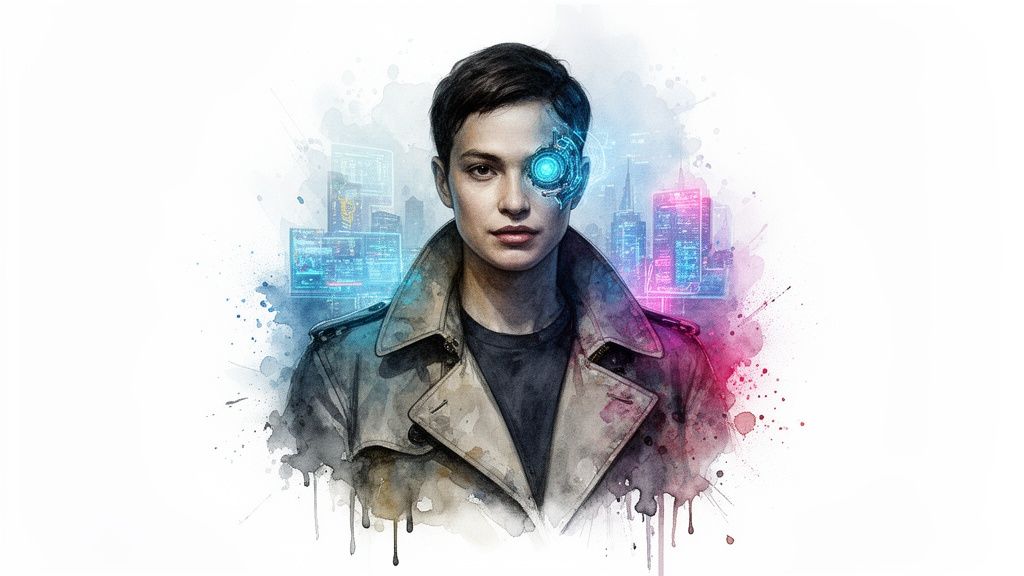
High Tech, Low Life: The Birth Of The Genre
Cyberpunk didn't just show up one day, fully formed with trench coats and neon kanji. It was forged in the pages of cautionary fiction, a literary gut-check from the early 1980s that looked at where technology and corporate power were headed and asked, "Are we sure this is a good idea?"
Before it was a look, cyberpunk was a feeling—a specific, gritty anxiety about the future. This is the origin story. It's where the central conflict of "high tech, low life" was born, laying the intellectual groundwork for every rain-slicked alley and flickering hologram that followed.
The Word And The World
Every movement needs a name. This one got its label from author Bruce Bethke, who coined the term "cyberpunk" for his 1983 short story. It was the perfect mashup, capturing the fusion of futuristic cybernetics with a rebellious, anti-establishment punk attitude. It stuck because it so perfectly described the people in these new worlds: outsiders using technology to fight a system that had already thrown them away.
But while Bethke gave it the name, it was William Gibson's 1984 novel, Neuromancer, that gave the genre its soul. The book exploded into the cultural zeitgeist, snagging the Hugo, Nebula, and Philip K. Dick Awards in a clean sweep. Gibson's vision of cyberspace, "console cowboys" jacking into the matrix, and godlike corporations called "zaibatsus" laid all the essential groundwork. He didn't just write a story; he built a world so tangible it felt less like fiction and more like a disturbing premonition.
Foundational Ideas of Cyberpunk Art
Before the iconic cyberpunk design took over cinema and video games, it was a philosophy built on a few core ideas. These are the bedrock of the entire aesthetic—the "why" behind the visuals. Getting a handle on them is the key to understanding why this dark future still has such a tight grip on imagination.
The pillars of the genre are pretty straightforward:
- Corporate Dystopia: Forget governments. In the cyberpunk future, they're weak or totally irrelevant. Monolithic corporations have taken over, controlling everything from your breakfast cereal to private armies. This power imbalance is where all the good conflict comes from.
- Human-Machine Integration: The line between flesh and machine has gotten blurry. Cybernetic limbs, artificial intelligence, and digital consciousness aren't just theories—they're part of daily life, raising some heavy questions about what it even means to be human anymore.
- Urban Decay and Density: The megacity is a character in itself. It's a sprawling, vertical jungle—overcrowded, polluted, and brutally divided. The super-rich live in sterile, inaccessible towers, casting long shadows over the vibrant, chaotic, and often dangerous street life below.
This trifecta creates the signature "low life" component. It's a world of immense technological progress that has utterly failed to solve basic human problems. In fact, it's made them worse, amplifying inequality and alienation. It's a warning that feels just as urgent today as it did back in 1984.
The Holy Trinity Of Cyberpunk Cinema
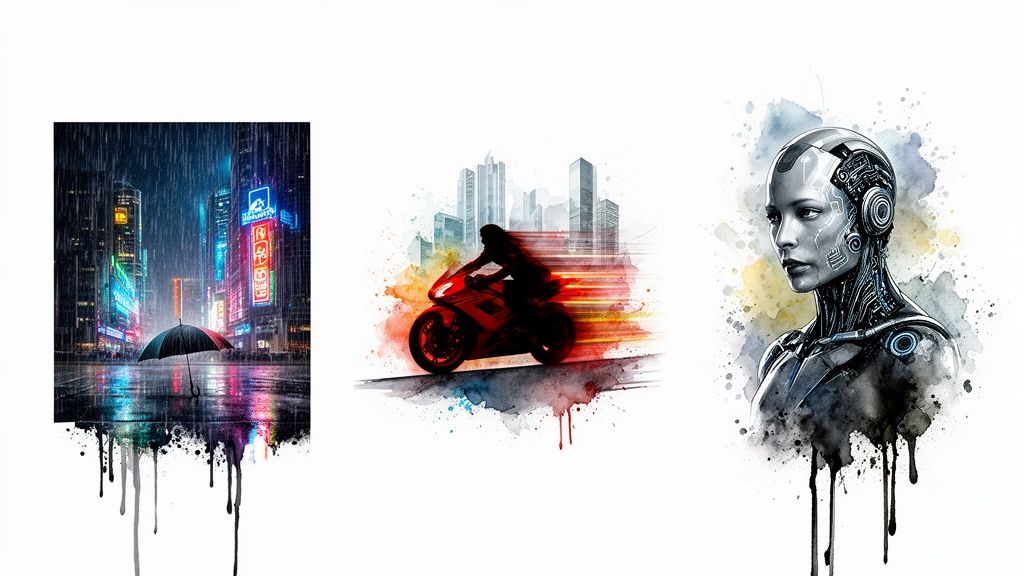
The jump from page to screen is where the cyberpunk art style really found its visual soul. Authors like Gibson gave the philosophical blueprint, but a trio of groundbreaking films translated that literary angst into an unforgettable visual language. These three aren't just influential; they're the bedrock the entire visual understanding of the genre is built on.
Without them, the cyberpunk style we know today—all rain-slicked asphalt and flickering neon—simply wouldn't exist. They are the holy trinity, and each one brought a crucial piece to the puzzle.
Blade Runner (1982): The Moody Blueprint
Ridley Scott's Blade Runner is the Genesis story of cyberpunk visuals. Set in a perpetually dark and rainy Los Angeles of 2019, the film established the core look and feel of the entire aesthetic. It took the "high tech, low life" concept and made it tangible, showing a future of flying cars and sentient androids set against a backdrop of overflowing street markets and urban decay.
Its visual contributions are legendary:
- Atmospheric Noir: The constant downpour and shadows weren't just for mood. They created a canvas where neon light could reflect and bleed, turning the city into a watercolor of blues, reds, and purples.
- Vangelis's Score: The mournful, synth-heavy soundtrack became the official sound of a lonely future, perfectly capturing the melancholy of a world that has lost its way.
- Cultural Fusion: The iconic neon kanji signs cemented the idea of a globalized, multicultural metropolis where East Asian influences became a key part of the visual shorthand.
Blade Runner proved that a dystopian future could be hauntingly beautiful. It made people want to live in its sad, gorgeous world—a contradiction that still sits at the heart of the aesthetic's appeal.
Akira (1988): The Anarchic Energy
If Blade Runner was a slow, contemplative poem, Katsuhiro Otomo's Akira was a full-blown punk rock anthem screamed at the top of its lungs. Set in the sprawling, chaotic metropolis of Neo-Tokyo after a world-shattering explosion, Akira injected the genre with a dose of raw, anti-authoritarian energy.
It traded the noir detective story for motorcycle gangs, psychic espers, and corrupt government conspiracies. Akira showed that cyberpunk wasn't just about mood; it was about rebellion.
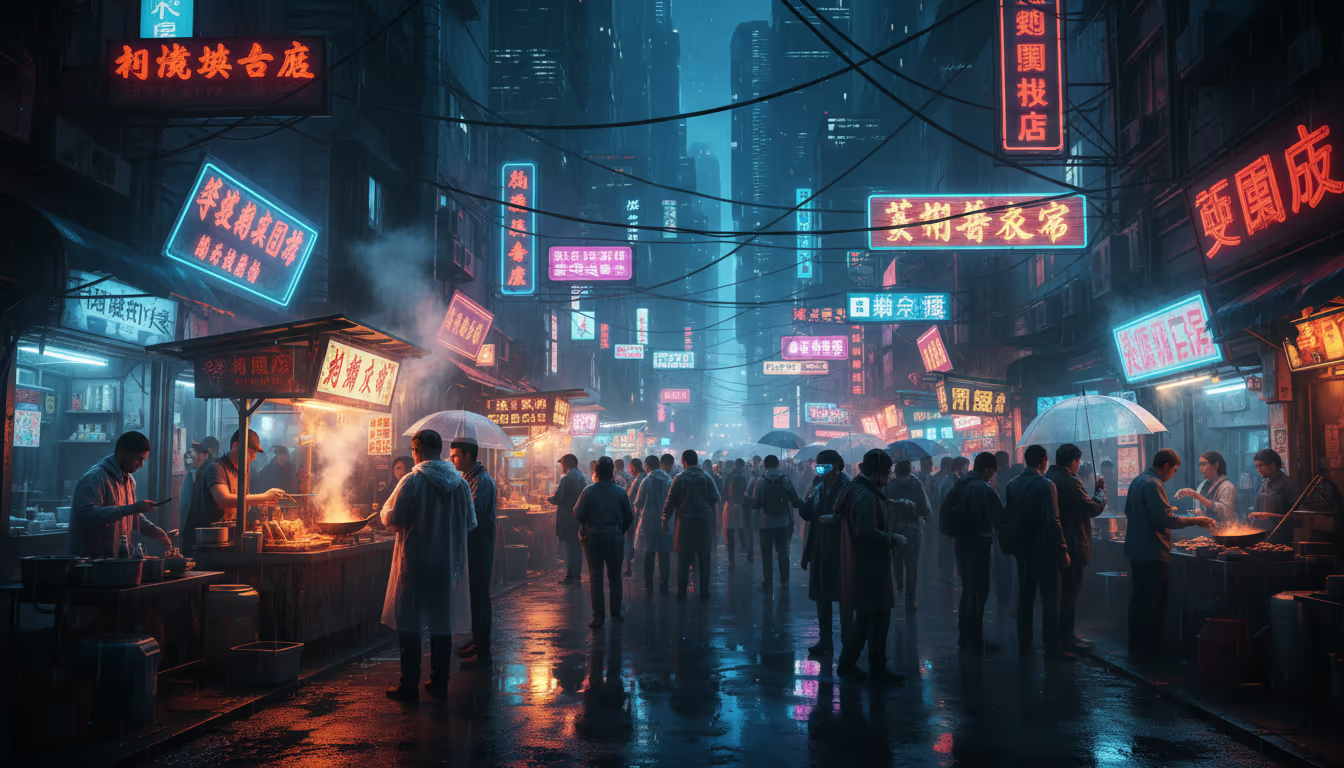
The film's meticulously hand-drawn animation brought a level of detail to urban chaos that had never been seen before. Every cracked pavement and piece of graffiti in Neo-Tokyo felt alive, grounding its fantastical elements in a believable, gritty reality.
Its legacy is defined by motion and scale. The famous "Akira slide," where Kaneda brakes his futuristic motorcycle, has been copied and parodied countless times. The film's depiction of urban destruction and social unrest added a kinetic, violent energy to the cyberpunk aesthetic.
Ghost in the Shell (1995): The Philosophical Core
Mamoru Oshii's Ghost in the Shell took the philosophical questions simmering beneath cyberpunk's surface and put them front and center. While it has striking action and a beautifully realized futuristic city, its real focus is on identity in a world of advanced cybernetics.
The film relentlessly asks the big questions: Where does the human end and the machine begin? If your memories can be hacked and your body replaced, what is left of your "self"?
Its visual style is cleaner and more contemplative than its predecessors, blending moments of quiet introspection with complex action. The sight of Major Motoko Kusanagi, a full-body cyborg, navigating this world became the definitive image of transhumanism for a generation. Ghost in the Shell cemented the idea that the deepest struggles in a cyberpunk future aren't fought on the streets, but inside the mind.
The Visual DNA Of A Neon-Drenched Future
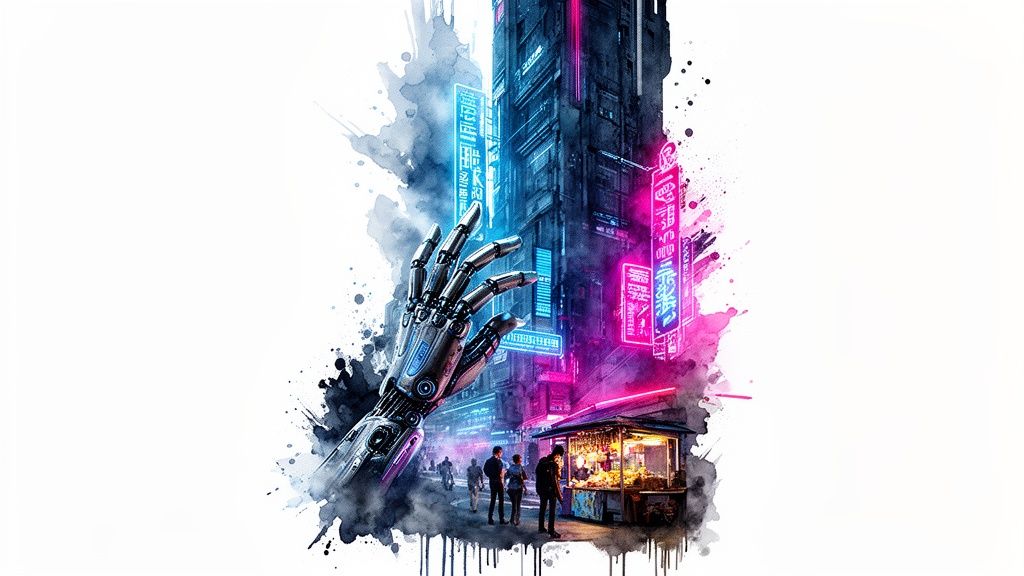
While cyberpunk philosophy can get complicated, its visual language is surprisingly consistent. It's a specific recipe of light, architecture, and attitude. Once you learn to spot the ingredients, they turn up everywhere, from video games to fashion. This is a field guide to that neon-drenched future—the core components that make a scene feel authentically cyberpunk.
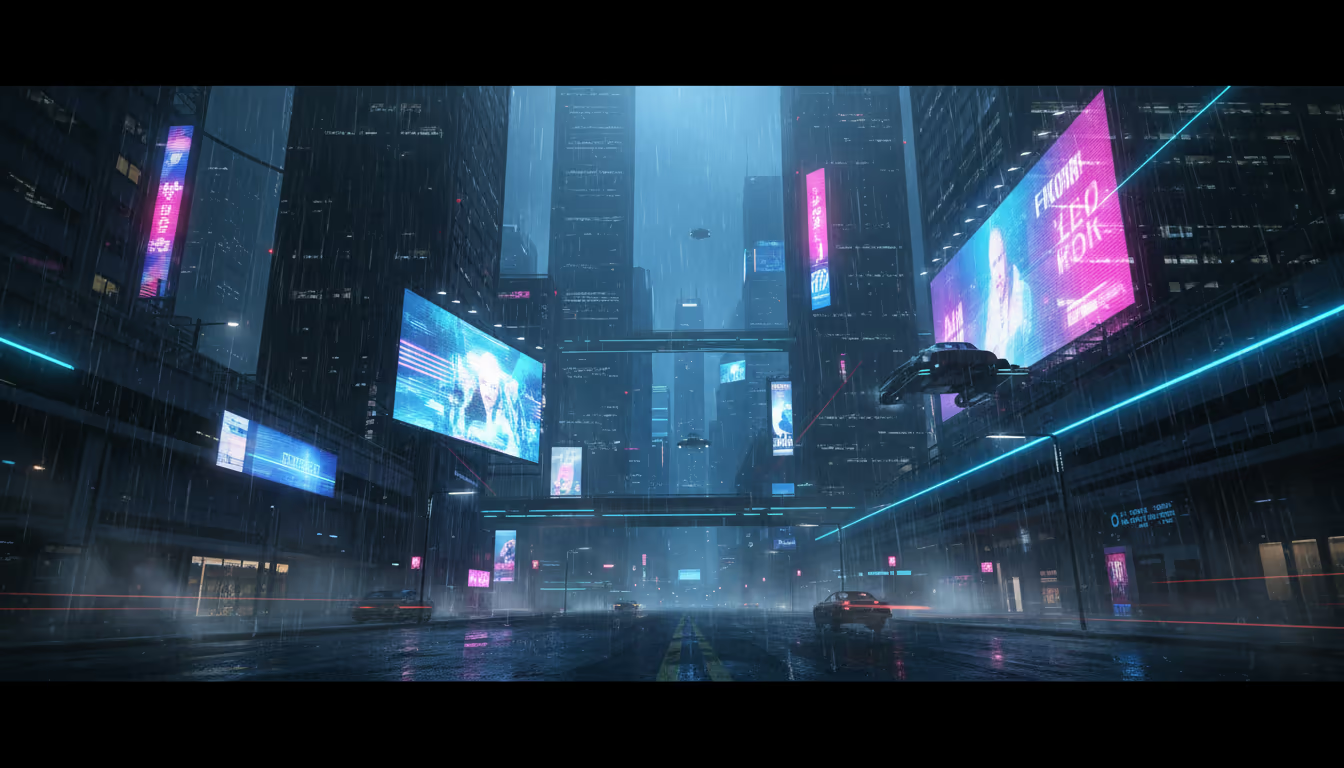
It all starts with the environment. The classic cyberpunk city is trapped in a perpetual, miserable night, usually with a never-ending drizzle. This isn't just for mood lighting; the darkness and wet surfaces are the perfect canvas for the real star of the show: neon.
Light And Color
The color palette is the first thing to notice. It's all about high contrast—deep, inky blacks punctuated by shockingly vibrant light. The dominant colors are electric blues, purples, and magentas, often clashing with acidic greens and fiery oranges.
This isn't just decoration. The light signifies technology's relentless creep into the dark corners of the world. Holographic ads flicker and glitch on the sides of immense buildings, promising a better life that's always just out of reach. Street-level signs, often in Japanese Kanji or Chinese characters, point the way to ramen shops and back-alley clinics. This visual noise is essential, creating a sense of overwhelming sensory input. To see this in action, check out the neon aesthetic.
Architecture And Augmentation
Cyberpunk architecture is built on scale and disparity. Soaring megastructures owned by faceless corporations dominate the skyline, casting literal and figurative shadows over the cluttered, chaotic streets below. This verticality is a powerful visual metaphor for the massive gap between the powerful and the powerless.
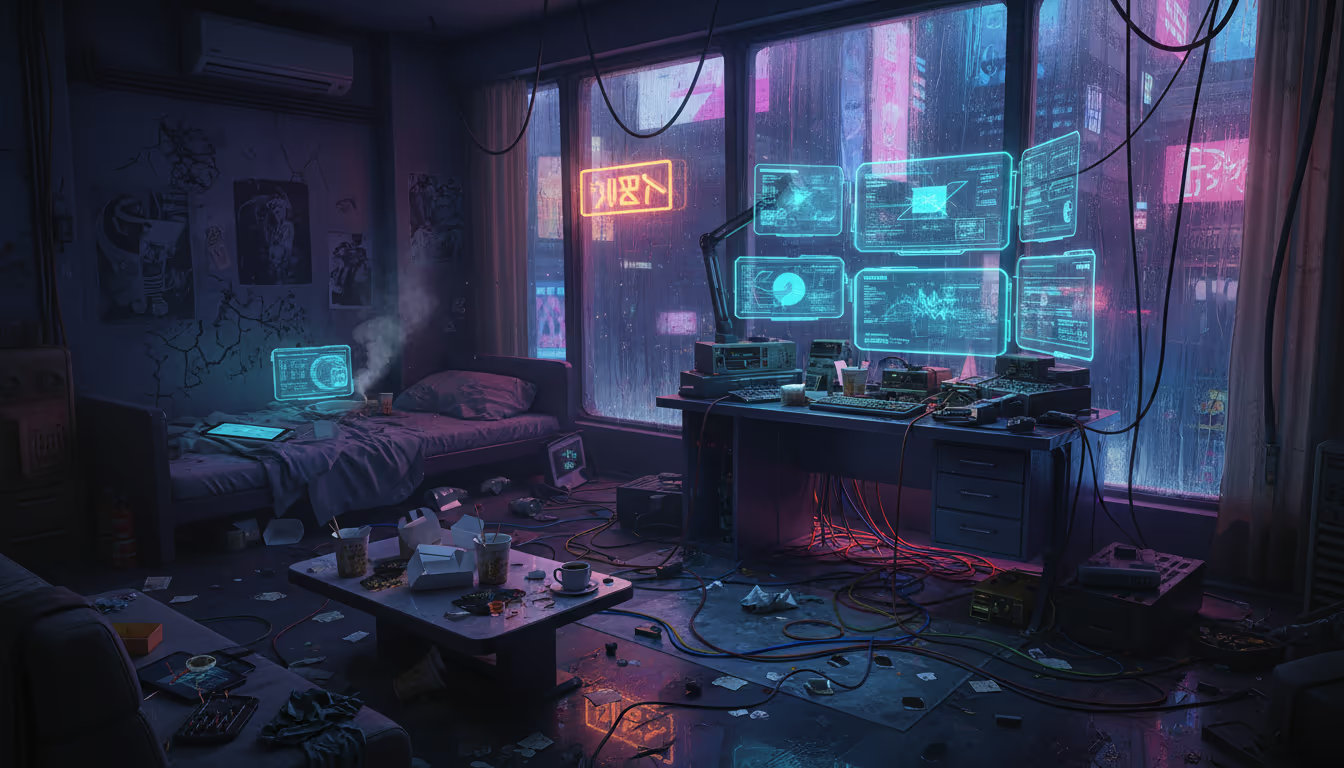
Down on the street, it's a messy, vibrant collage of cultures. Cramped markets, makeshift stalls, and tangled wires create a feeling of density and decay. It's a world built in layers, with old, crumbling structures retrofitted with advanced tech like CRT monitors in dark rooms.
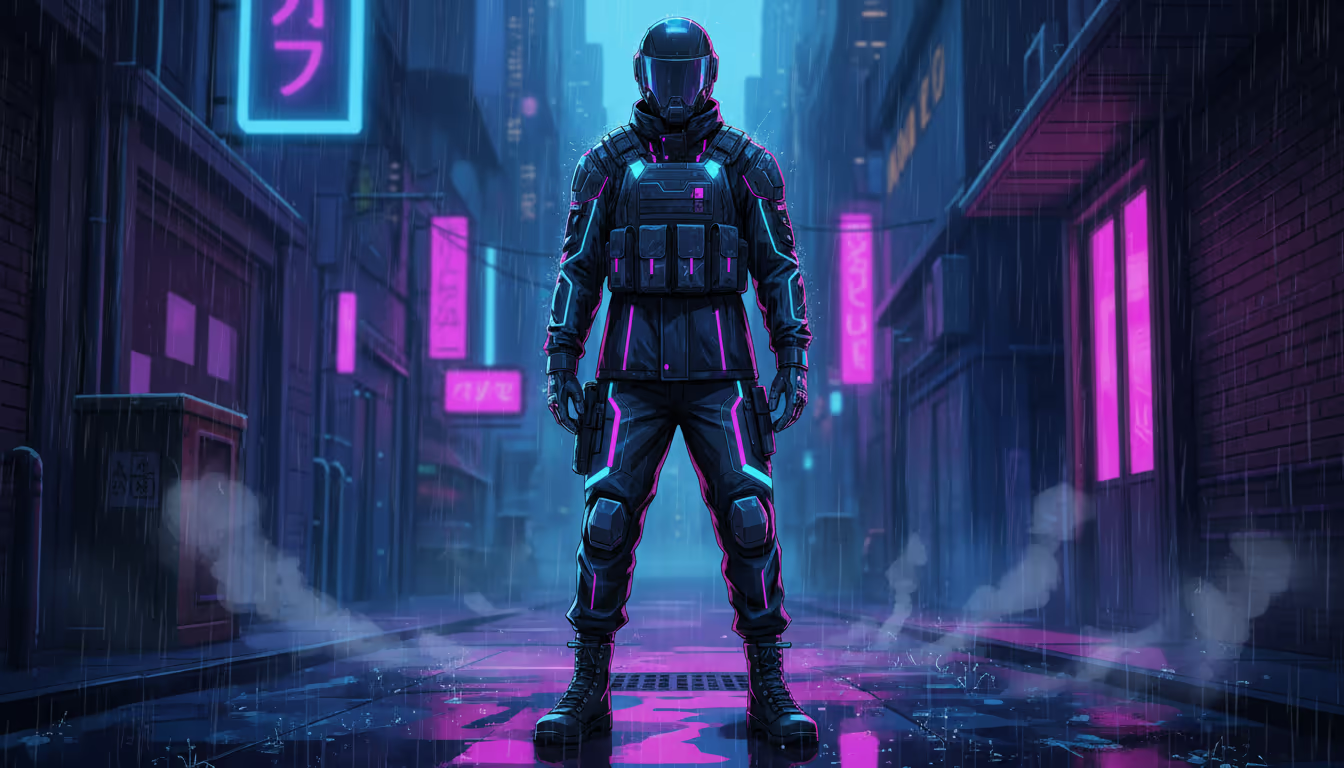
The people who live here often reflect their environment. Cybernetic augmentations are common, from glowing optic implants to sleek prosthetic limbs. This isn't idealized transhumanism; it's about survival. Technology is a tool, a status symbol, or a necessary burden.
From Dystopian Warning To Aspirational Vibe
Here's the strange twist at the heart of the modern cyberpunk aesthetic: a genre born from dark warnings about corporate overreach and losing humanity is now something people want. It went from fearing the neon-drenched future to trying to decorate apartments like a scene from it. What happened?
The short answer: the warnings came true, just not in the way the 80s imagined. We got the megacorporations, the constant surveillance, and the shaky digital identities. We just didn't get the cool flying cars or cybernetic arms to go with them. So when we see that world on screen, it's not some terrifying, alien future anymore. It's a hyper-stylized version of reality, but with better rain and much cooler outfits.
The Modern Resurgence
After laying low for a while, cyberpunk came roaring back in the late 2010s, thanks to a new holy trinity of media.
First came Denis Villeneuve's Blade Runner 2049 (2017). The film didn't just copy the original's look; it evolved it. It traded the perpetual noir night for moments of hazy orange daylight and sterile, minimalist interiors, proving the aesthetic could grow beyond its roots while keeping its melancholy soul.
Then came the video game Cyberpunk 2077. Despite a notoriously rocky launch, its world—Night City—became the most immersive, detailed vision of the aesthetic ever built. Players could lose themselves for hundreds of hours in its streets, and after a long redemption arc, it's now beloved. It wasn't just a game; it was a place to inhabit.
Finally, the anime Cyberpunk: Edgerunners (2022) hit a whole new generation like a shot of adrenaline. Its tragic story and hyper-kinetic style reminded everyone of the genre's punk-rock heart and human cost, creating a massive cultural moment.
Wanting The Vibe Without The Dystopia
This modern comeback highlights a fundamental shift. The aesthetic got cleanly separated from the dystopia. People want the cool apartment overlooking a neon-soaked city, but would rather pass on the acid rain and corporate assassins.
It's a form of curated rebellion. Can't dismantle a megacorp on a lunch break, but you can make your desktop look like a console cowboy's command center. The cyberpunk style has become a way to feel connected to that rebellious, high-tech world without dealing with any of the actual suffering.
This is why the aesthetic is more popular than ever. It gives the visual thrill of a technologically saturated future while letting people sidestep the grim reality it once warned about. It's less of a cautionary tale and more of a moodboard—and it's a moodboard that looks incredible on a lock screen.
Bring The Future To Your Mac Desktop
Alright, the tour is done. You've walked the rain-slicked streets and stared up at the glitching holographic billboards. Now what? While installing cybernetic optics is probably a few years out, you can absolutely give your Mac a serious cyberpunk upgrade today. This is where the aspirational vibe meets your actual screen.
Be real—you're going to be staring at your Mac for hours. It might as well look like a scene out of Blade Runner instead of another default mountain range. This is the whole point—making the digital spaces you inhabit feel a little less corporate and a lot more inspiring.
Your Mac, Upgraded
This is where gifPaper for Mac comes in. Think of it as the ripperdoc for your desktop. It's the first and only app that brings real, native live wallpapers to your Mac's lock screen—not some janky overlay, but the same system Apple uses, so it slows down gracefully as you unlock.
Your desktop can be a full 4K animated loop, or if you need to focus, a crisp, high-res still frame. Screen savers? They're cool again, because now they're actually worth looking at. Your Mac can finally match the high-tech, low-life future you've been reading about.
The Cyberpunk Starter Pack
Nailing the cyberpunk style is all about atmosphere. It's the glow of neon on wet pavement, the oppressive beauty of a city that never sleeps, and the quiet melancholy of a futuristic apartment looking out over it all. With a library of over 150 looping 4K wallpapers, gifPaper has all the key ingredients.
The collections are basically starter packs for a personal digital dystopia:
- The neon wallpaper collection is the obvious first stop, packed with glowing signs and electric cityscapes.
- The dark wallpaper selection provides the perfect moody backdrop for all that vibrant light.
- The purple wallpaper options deliver that signature cyberpunk art palette.
For a one-time purchase of $4.99—that's the launch price—you get to own a piece of the future. No subscriptions, just a better-looking Mac.
Can't jack into the matrix just yet. But you can make your lock screen look like the terminal you'd use to do it. It's the next best thing.
There's a 7-day free trial with full access to every feature and all the wallpapers. No credit card required. Give it a shot and see if your Mac doesn't suddenly feel a lot more interesting.
Ready to give your Mac a taste of that neon-drenched future? gifPaper is the first and only app to bring native 4K live wallpapers to your Mac's lock screen, desktop, and screen saver. Browse over 150 looping scenes and start your 7-day free trial at gifpaper.com/macos-app.