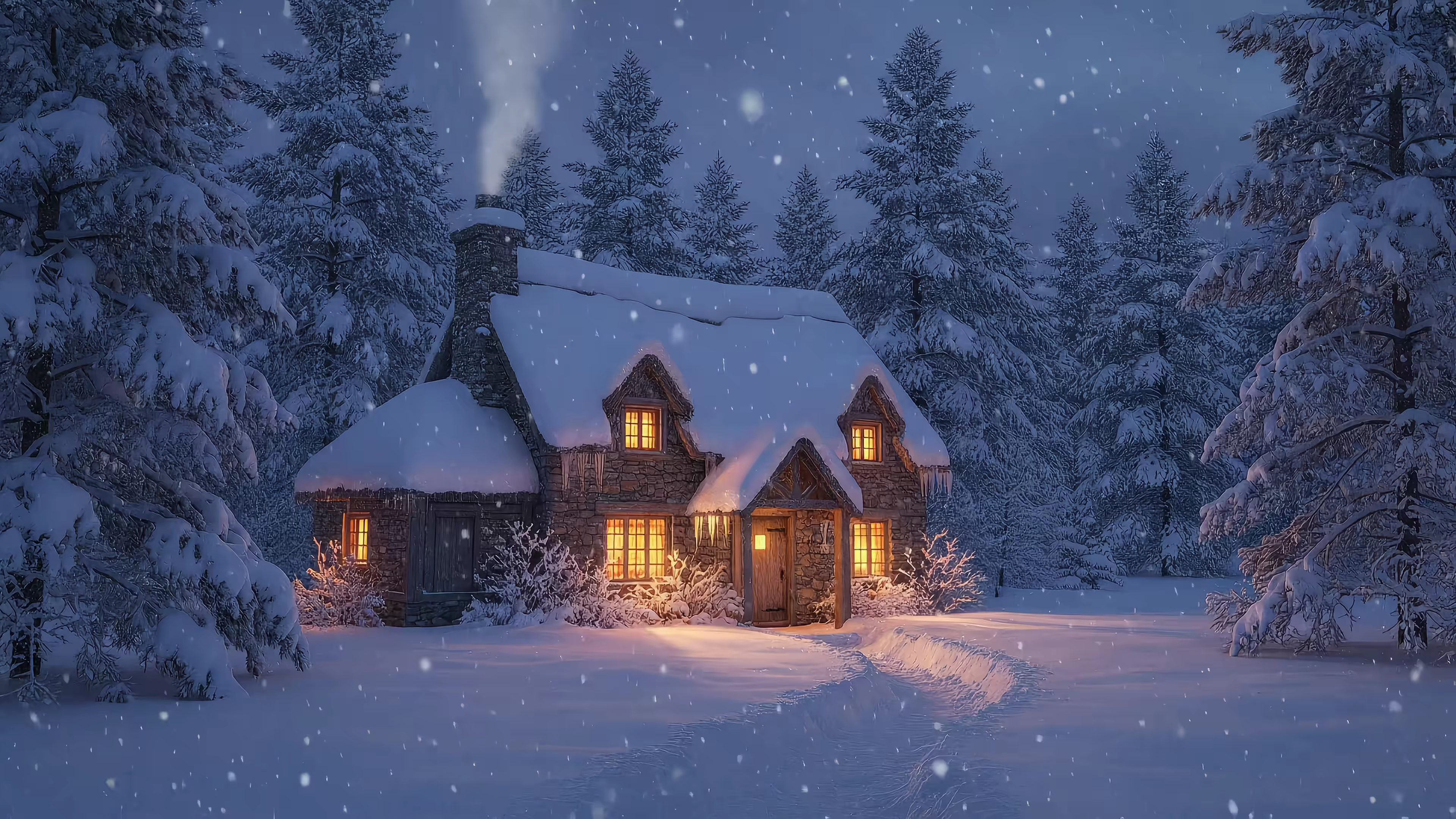
Above the Fray: A Guide to Finding Calm in a Loud World
Your phone buzzes. A group chat is arguing about politics. Your inbox has acquired that faintly supernatural quality inboxes get when you ignore them for three hours. Somewhere, a news app is insisting that everything is urgent, historic, and bad.
So yes, the fray is doing great.
Many people know the feeling even if they don't have the phrase for it. You want to stay informed, responsive, and vaguely functional. You do not want your nervous system to become a public utility for every notification that wanders by. That's where above the fray starts to sound less like a slogan and more like a survival skill.
There's also a practical side to it. Your screens shape your mood more than most admit. If your laptop is the place where messages pile up, headlines multiply, and tiny red badges perform their little anxiety tap dance, then it helps to give that same screen some counterweight. Calm has to live somewhere.
The Opposite of 'Doomscrolling'
At 8:14 a.m., you open your laptop to check one thing. A perfectly innocent act. Five minutes later you've skimmed a tense email, glanced at a messy headline, seen a stranger's terrible opinion presented with gladiatorial confidence, and somehow ended up reading a comment thread that has the spiritual texture of a leaf blower.

That whole cycle is the opposite of being above the fray. Doomscrolling drags you downward, into immediacy, irritation, and that weird sensation that your attention has been rented out by the minute. Being above the fray doesn't mean floating off to a mountain cave and living on tea. It means keeping some altitude. You still see what's happening. You just don't let every passing disturbance move into your bloodstream and start rearranging the furniture.
The modern fray is mostly ambient
A lot of conflict today isn't direct conflict. It's environmental. It sits around you like weather.
- Notifications interrupt before your brain has chosen a priority.
- Feeds flatten everything into the same visual strip, so a war headline and a celebrity haircut occupy identical real estate.
- Work chat makes every half-thought look like it deserves immediate response.
That's why so many people end up craving quieter rituals. A playlist. A walk. A desktop that doesn't look like the inside of a vending machine for stress. If you already like that low-pressure, slightly cocooned atmosphere, the whole culture around lofi study music makes sense. It's less about productivity wizardry and more about creating a room in your head where things stop shouting.
Practical rule: Wanting less noise isn't laziness. It's often just your brain filing a perfectly reasonable workplace complaint.
The useful twist here is that "above the fray" gives language to something people already do instinctively. They mute. They step back. They stop checking one more app. They choose visual spaces that calm them down instead of winding them up.
That isn't withdrawal. It's maintenance.
What 'Above the Fray' Actually Means
At its simplest, above the fray means staying composed when everyone else is busy rolling downhill in a barrel of noise. You keep perspective. You don't join every fight. You resist the temptation to treat every disagreement as a summons.
That can sound a bit smug if handled badly, like someone announcing they've transcended earthly concerns while still checking replies every six minutes. But the phrase has older, heavier roots than modern self-help varnish.
A phrase with institutional weight
Historically, the phrase is tied to institutions meant to stand outside day-to-day political brawling. A good example is the U.S. Supreme Court. The ideal of judicial neutrality, rooted in the Constitution of 1787, is that the Court remains "above partisan squabbles" so it can keep legitimacy as a final arbiter for the nation, as discussed in BackStory's episode on "above the fray".
That's the core idea. Not innocence. Not ignorance. Distance with responsibility.
The point wasn't that judges would never face political pressure. Of course they would. The point was that some institutions only work if people believe they answer to principle rather than daily factional combat. "Above the fray" describes that posture.
Being above the fray is not the same as being absent from reality. It means reality doesn't get to jerk your attention around by a leash.
What people usually get wrong
Readers often confuse the phrase with one of two things:
| Misread | What it actually means |
|---|---|
| Apathy | You still care. You just don't react to everything on contact. |
| Moral superiority | It's less "I'm better than this" and more "I don't need to be swallowed by this." |
There's also a small, mildly comic clarification worth making. "Above The Fray" is also the name of an ecommerce agency that positions itself as an end-to-end global ecommerce partner covering consulting, design, build, integration, and ongoing evolution, according to its Clutch profile. Perfectly respectable. Not what I mean here. I'm talking about the idea, not platform architecture or a haunted maze of brittle ERP integrations.
The useful definition
If you want a plain-English version, use this:
- You notice conflict without volunteering to become part of it.
- You stay informed without letting information colonize your mood.
- You keep your standards, even when the room gets louder.
That last bit matters. Above the fray is not passivity. It's selective involvement. You choose when to enter the mess, and you try not to come back wearing it like a hat.
Why People Crave a View from Above
People don't start wanting distance for no reason. Usually they want it because immersion has become exhausting.
News, work, and social media now arrive in the same glowing rectangle, often within the same five-minute window. Your brain barely gets to separate "important," "annoying," "sad," and "pointless," because everything shows up with identical urgency. No wonder so many people fantasize about psychic altitude.

Detachment can be healthy
This impulse isn't just personal whim. The Reuters Institute's 2024 Digital News Report found that a significant share of audiences actively avoid news because it makes them feel overwhelmed and powerless, which supports the idea that detachment can be a boundary-setting response to information overload, as summarized in the material provided here.
That's a useful correction to the usual guilt script. If you pull back sometimes, it doesn't automatically mean you're selfish, uninformed, or spiritually made of beige drywall. It may mean your attention has hit capacity.
The problem isn't only the news
Work plays its part too. A lot of modern professionalism now involves being visibly available. Messages, meetings, public channels, performative certainty on LinkedIn. Plenty of people feel pressure to have a take, share the take, defend the take, and then smile as if this is all a normal use of Tuesday.
A calmer response is often more intelligent than a faster one.
- Not every prompt deserves an opinion
- Not every opinion deserves publication
- Not every publication deserves your pulse rate
Selective attention is not ignorance. It's a way of deciding what gets access to your mind.
That desire for distance often shows up visually before it shows up verbally. People choose mountain scenes, night skies, quiet rooms, empty roads, snowfall, anything that gives the eye a wider horizon than the one provided by Slack.
A wallpaper like that works because it changes the emotional weather of the screen. It says: yes, the world is noisy. No, your desktop doesn't have to participate.
The Visual Language of Serenity
Once you know the feeling you're after, you start seeing that "above the fray" has a visual grammar. Not one fixed style, but a family resemblance. Certain scenes create psychological distance almost immediately.

Vastness makes your problems behave
The first theme is scale. Night skies, distant mountains, open water, cosmic emptiness. These images work because they reduce the size of whatever nonsense was trying to become the center of your day.
A galaxy wallpaper is not going to answer your emails. Shame, really. But it can remind you that an annoying thread is not the whole universe. Vastness gives perspective without lecturing you about perspective, which is preferable because nobody enjoys being spiritually scolded by decor.
Order calms the eye before it calms the mind
The second theme is structure. Minimal scenes, raked sand, clean geometry, a single object placed with intention. These visuals feel restful because they withhold clutter.
That's why gardens and pared-back natural compositions are so effective. They make quiet look deliberate. If you like that idea in physical space too, these succulent garden design ideas are a good example of how simple forms, repetition, and negative space can create calm without becoming sterile.
A serene image usually does one of two things. It widens your view, or it reduces visual argument.
Solitude without loneliness
The third theme is peaceful aloneness. A cabin at dusk. A dim reading room. A train window in the rain. One lamp on, one person implied, no one demanding anything.
People sometimes get confused. Solitary imagery isn't antisocial. It's protective. It suggests there's value in being briefly unreachable, or at least emotionally unhooked from the crowd. That's very much the spirit of being above the fray. Not exile. Shelter.
A quick cheat sheet helps:
- Choose vast scenes if you need perspective and emotional breathing room.
- Choose minimal scenes if clutter itself makes you tense.
- Choose solitary scenes if your life feels over-socialized and over-signaled.
None of this is magic. It's just design doing what design does best. Telling your body what kind of room it's in.
Curating Your Digital Escape
Once you start looking for this mood on purpose, certain wallpaper styles do the job better than others. "Above the fray" isn't really a genre. It's a filter you apply to a genre. You're asking one question: does this image create distance from noise, or does it add more of it?
That makes curation easier.
Four directions that work
If you want a calmer screen, these categories tend to pull in the right direction:
- Nature for perspective. Forests, snow, water, mountains. The point is not rustic virtue. The point is that nature scenes don't demand a hot take. The nature wallpaper collection is useful when you want your desktop to feel less like a dashboard and more like a deep breath.
- Space for altitude. Stars and cosmic views are excellent for shrinking petty drama back to human size. The space wallpaper collection is basically perspective in visual form.
- Minimal for order. If your brain is already handling enough visual clutter, simpler compositions help. The minimal wallpaper collection leans into that cleaner, quieter look.
- Dark for lower sensory volume. Some screens practically shout. Darker scenes tend to murmur, which is often an upgrade. The dark wallpaper collection is good when you want atmosphere without commotion.
If you like tuning your whole setup around a specific mood, this guide to a MacBook wallpaper aesthetic is a handy companion. Same basic instinct. Less chaos, more intentional screen energy.
A few examples of the mood
Some wallpapers decorate a screen. Others set a boundary.
What to avoid
A wallpaper can be beautiful and still be wrong for this job. If you're trying to feel above the fray, skip anything that feels frantic, overcrowded, or aggressively performative. You don't need your desktop trying to out-yell the internet.
A good test is embarrassingly simple. Open the image and ask: does my breathing get slower or faster? If it gets faster, lovely image, wrong assignment.
Make Your Mac a Sanctuary Not an Office
Your Mac is where the fray shows up for work. Messages land there. News tabs bloom there. Calendars glare at you from there with the moral conviction of tiny bureaucrats. If you want more calm in daily life, that machine is an obvious place to start.

Calm should begin before the first click
A peaceful screen does something useful before you've done any work at all. It changes the opening note of the day. Wake your laptop, and the first thing you see can be spacious, quiet, and unhurried instead of bland or busy.
That matters more than people think. Visual atmosphere isn't fluff when you spend hours looking at the same device. It's part of the environment, same as desk light, chair height, or the fact that some people can only think properly if there's a mug nearby performing its ancient ceremonial role.
If you're also sorting out the practical side of your setup, this roundup of top productivity apps for Mac is a sensible companion read. Useful tools are great. They just work better when your desktop doesn't feel like an airport terminal for urgent nonsense.
A sanctuary is built from small choices
You don't need a monk's cell or a designer loft. You need a few choices that push your computer away from friction and toward ease.
- Pick imagery with emotional range. Quiet doesn't have to mean dull.
- Let the desktop rest. Not every surface needs to perform.
- Treat customization as environmental design. The guide to customize your Mac desktop is a good starting point if your current setup still feels like factory settings plus regret.
Your computer can be functional without looking emotionally available to every passing crisis.
That's really the heart of it. "Above the fray" is not a command to stop caring. It's permission to create a little altitude. Sometimes that starts with boundaries, sometimes with attention, and sometimes with the humble act of making the screen in front of you less noisy than the world behind it.
If you want to put that feeling directly on your Mac, gifPaper is the neat little contraption for the job. It gives you a curated library of 150 smoothly looping 4K live wallpapers with ambient music, and the Mac app sets them as your lock screen, desktop, and screen saver. It's a $4.99 one-time purchase, not a subscription. There's also a 7-day free trial with no credit card required, a 30-day money-back guarantee, and it works on macOS 13 or later. If your screen is going to occupy a large chunk of your day, it might as well look like a place you'd want to be.